
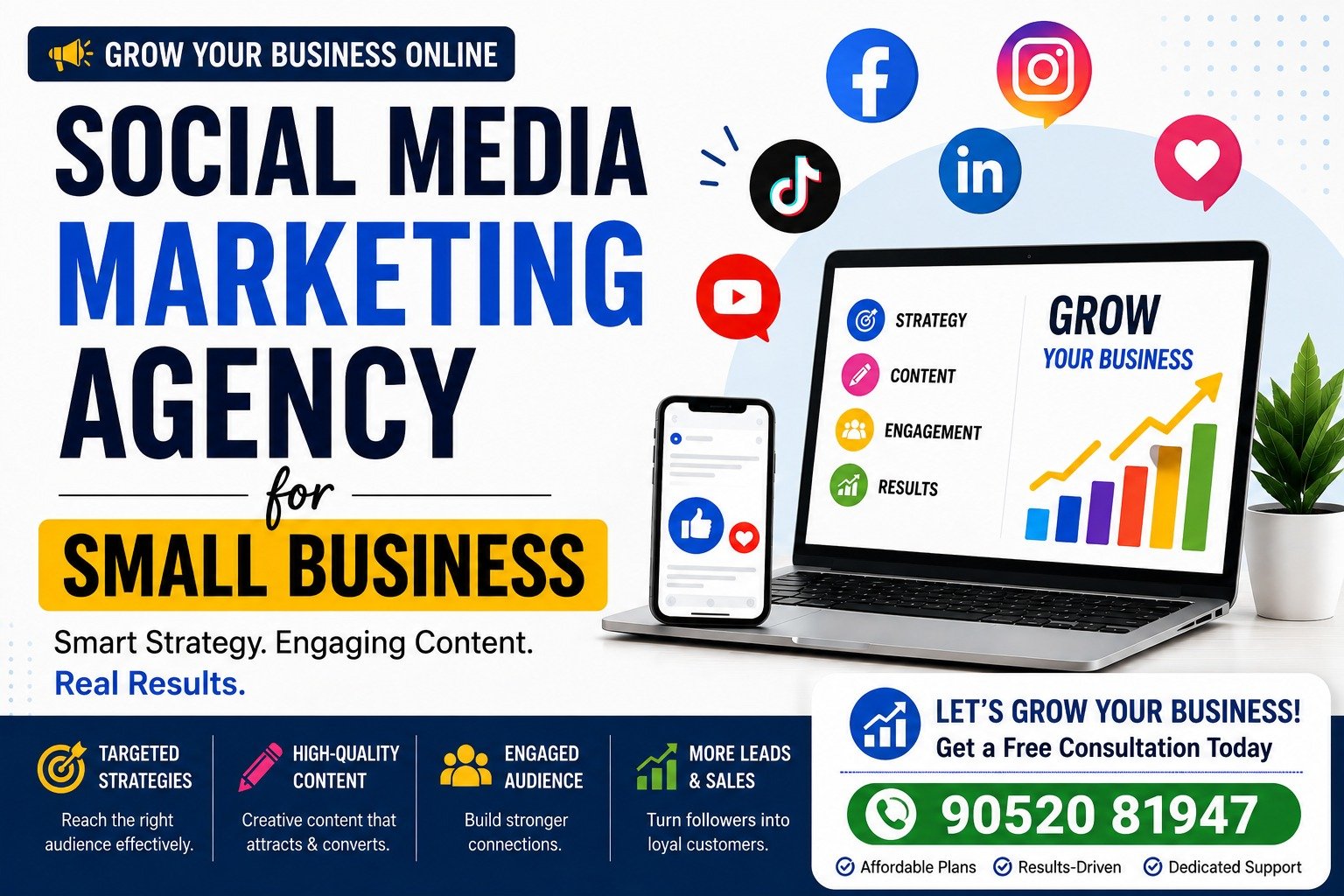
Running a small business requires you to manage many responsibilities at the same time. You may be handling customers, sales, employees, operations, and finances while also trying to maintain your online presence.
Social media can be an effective way to connect with potential customers, but creating content consistently, responding to enquiries, managing campaigns, and tracking results can become time-consuming.
This is where a social media marketing agency for small business can help.
A professional agency can develop a social media strategy around your business goals, create relevant content, manage your social platforms, run advertising campaigns, and measure performance. Instead of simply posting content, the focus is on using social media as part of a broader marketing and customer-acquisition strategy.
In this guide, you’ll learn what a social media marketing agency does, how it can benefit a small business, how much these services may cost, and how to choose the right agency for your needs.
What Is a Social Media Marketing Agency for Small Business?
A social media marketing agency for small business provides professional services to help businesses use social platforms to increase visibility, communicate with their target audience, promote products or services, and generate business opportunities.
Depending on the agency and package, services may include:
- Social media strategy
- Audience research
- Content planning
- Social media management
- Graphic design
- Short-form video content
- Community management
- Social media advertising
- Lead-generation campaigns
- Performance tracking
- Monthly reporting
The objective isn’t simply to increase the number of followers. A good strategy connects social media activity to meaningful business goals such as enquiries, website visits, leads, sales, and customer relationships.
For example, a local home-service company could use social media to share maintenance tips, answer common customer questions, demonstrate its work, and promote its services. This type of content can help potential customers understand the company’s expertise before they decide to contact it.
Why Social Media Marketing Matters for Small Businesses?
Social media gives small businesses an opportunity to communicate directly with potential and existing customers.
A well-planned social media presence can help your business:
Build Brand Awareness
People are more likely to consider a business they recognize and understand.
Consistently publishing useful and relevant content can help your business become more familiar to your target audience.
Reach Potential Customers
Social platforms can help businesses reach people based on factors such as interests, location, demographics, and professional characteristics, depending on the platform and advertising options available.
This can be particularly useful for local businesses that want to reach customers in a specific service area.
Increase Customer Engagement
Social media allows businesses to have conversations with their audiences.
Comments, direct messages, polls, questions, and other interactions can help businesses understand customer needs and build relationships.
Generate Leads
Social media can contribute to lead generation through:
- Website traffic
- Direct messages
- Lead forms
- Consultation offers
- Product enquiries
- Promotional campaigns
- Educational content
A strong social media strategy can move people from simply discovering your business toward taking a meaningful next step.
Support Website Traffic
Social media content can direct interest users to:
- Blog posts
- Service pages
- Product pages
- Landing pages
- Contact forms
- Online booking pages
Social media should therefore work alongside your website rather than operate as a separate marketing activity.
What Does a Social Media Marketing Agency Do?
A professional social media agency may handle several important parts of your online marketing.
- Social Media Strategy
A strategy provides direction for your social media activities.
An agency may analyse:
- Your target audience
- Competitors
- Business objectives
- Existing social profiles
- Content opportunities
- Suitable platforms
- Advertising opportunities
The result should be a practical plan that explains what content to create, where to publish it, who to target, and how success will be measured.
- Social Media Management
Social media management can include:
- Content scheduling
- Publishing posts
- Monitoring comments
- Responding to messages
- Managing content calendars
- Reviewing performance
Outsourcing these activities can save business owners time and help maintain consistency.
- Social Media Content Creation
Content is one of the most important components of social media marketing.
Depending on your business, an agency may create:
- Educational posts
- Promotional graphics
- Short videos
- Reels
- Carousels
- Infographics
- Customer-focused content
- Industry tips
- Frequently asked question posts
Good content should give people a reason to stop, learn, engage, visit your website, or contact your business.
- Social Media Advertising
Organic content can help build an audience, while paid advertising can help businesses reach selected audiences more efficiently for specific campaigns.
Social media advertising may be used for:
- Lead generation
- Website traffic
- Product promotion
- Event promotion
- Brand awareness
- Retargeting
- Special offers
An agency can help with campaign planning, audience selection, creative testing, budget management, and performance analysis.
- Social Media Lead Generation
A social media marketing agency can create campaigns designed to encourage potential customers to take action.
For example:
Educational post → Interested customer → Landing page → Enquiry form → Sales follow-up
The social media campaign is only one part of the process. The quality of the offer, landing page, sales process, audience, and follow-up can also influence the result.
- Analytics and Reporting
A professional social media strategy should be measured.
Depending on your objectives, useful metrics may include:
- Reach
- Engagement
- Website clicks
- Leads
- Enquiries
- Conversion rate
- Cost per lead
- Advertising spends
- Customer acquisition cost
The purpose of reporting isn’t simply to show numbers. It should help you understand what is working and what should be improved.
Benefits of Hiring a Social Media Marketing Agency for Small Business
Hiring a social media marketing agency for small business can provide several practical advantages.
Save Time
Business owners often have limited time.
Outsourcing social media management allows you to focus more attention on customers, operations, and business development.
Access Professional Expertise
Social media marketing involves more than creating attractive posts.
Strategy, audience research, content development, advertising, analytics, and conversion optimization all require different skills.
Maintain Consistent Content
A planned content calendar can help prevent long periods without publishing.
Consistency doesn’t mean posting constantly. It means developing a realistic schedule that your business can maintain.
Improve Your Online Brand
Professional content can help create a consistent visual and communication style across your social profiles.
This can make it easier for potential customers to understand what your business offers.
Reach the Right Audience
A strategy based on your target audience can be more useful than trying to reach everyone.
For local businesses, location-based marketing can be particularly relevant.
Make Better Marketing Decisions
Performance data can show which content and campaigns are generating meaningful engagement and business actions.
This allows future marketing decisions to be based on evidence rather than assumptions.
How to Choose the Right Social Media Marketing Agency
Choosing an agency is an important business decision.
Don’t select an agency solely because it has the lowest price or the largest number of followers.
Consider the following factors.
Relevant Experience
Look for experience that is relevant to your industry, audience, and business model.
Clear Strategy
The agency should be able to explain how it plans to help you achieve your objectives.
Transparent Pricing
Understand exactly what your package includes.
Ask whether the price covers:
- Content creation
- Social media management
- Advertising management
- Graphic design
- Video creation
- Reporting
- Strategy
Also clarify whether advertising spend is separate from the agency fee.
Clear Deliverables
Before starting, understand how many platforms will be managed, how much content will be produced, and what services are included.
Reporting
Ask how performance will be measured and how often you will receive reports.
Communication
A good working relationship requires clear communication.
Make sure you know who will be responsible for your account and how you can communicate with the agency.
Realistic Expectations
Be cautious of agencies that promise guaranteed followers, guaranteed sales, guaranteed viral posts, or instant results.
Marketing performance depends on many factors, including your industry, offer, competition, audience, budget, website, sales process, and content quality.
How Much Does Social Media Marketing Cost for a Small Business?
There is no single price for social media marketing.
The cost can depend on:
- Number of platforms
- Number of posts
- Content format
- Video requirements
- Social media management
- Advertising management
- Audience research
- Strategy development
- Reporting
- Agency experience
- Scope of work
One important distinction is the difference between the agency/service fee and your advertising budget.
For example, an agency may charge a monthly service fee for strategy, content, and management while your advertising budget is paid separately to the advertising platform.
Before signing an agreement, ask for a clear breakdown of what you are paying for.
Instead of asking only, “What is the cheapest social media package?”, consider asking:
“What marketing activities will give my business the best opportunity to achieve its goals within my budget?”
Social Media Marketing Agency vs Doing It Yourself
Both approaches can work depending on your situation.
Factor | DIY Social Media | Professional Agency |
Strategy | Managed by business owner | Professional planning |
Content creation | Owner/team | Agency team |
Time required | Higher for owner/team | Outsourced |
Social media management | Internal | Agency-managed |
Advertising | Self-managed | Professional campaign management |
Analytics | Self-monitored | Regular reporting |
Expertise | Depends on internal skills | Access to specialists |
Scalability | May become difficult | Easier to expand services |
DIY marketing may be suitable when you have the time and skills to manage your social channels.
Hiring an agency may make more sense when social media is taking too much of your time, you’re struggling to produce consistent content, or you want professional support with strategy and advertising.
Which Social Media Platforms Should Small Businesses Use?
You don’t need to be active on every social platform.
The best platform depends on your target audience and business objectives.
Facebook can be useful for local businesses, community engagement, promotional campaigns, and paid advertising.
Instagram can be valuable for visual businesses, products, services, short-form videos, Reels, and brand building.
LinkedIn can be particularly useful for B2B companies, consultants, agencies, recruiters, and professional services.
YouTube
YouTube can support educational content, demonstrations, tutorials, reviews, and long-form video.
Pinterest may be useful for businesses whose products or content are strongly visual and discovery oriented.
The key is to identify where your target customers are rather than trying to maintain every possible account.
Social Media Content Strategy for Small Businesses
A strong social media presence needs more than promotional posts.
Consider creating content across several categories.
Educational Content
Help your audience solve problems.
Examples include:
- How-to guides
- Tips
- Tutorials
- Checklists
- Industry information
- Frequently asked questions
Promotional Content
Tell customers about:
- Products
- Services
- Offers
- New launches
- Events
- Special packages
Trust-Building Content
Show the people and processes behind your business.
Examples include:
- Team introductions
- Behind-the-scenes content
- Business stories
- Customer feedback
- Work demonstrations
Engagement Content
Encourage people to participate through:
- Questions
- Polls
- Discussions
- Quizzes
- Opinions
A balanced content strategy helps prevent your social media page from becoming a constant stream of advertisements.
How Social Media Marketing Can Generate Customers
Social media usually works as part of a broader customer journey.
A potential customer might:
Discover your content → Visit your profile → Follow your business → Engage with your content → Visit your website → Submit an enquiry → Speak with your team → Become a customer
For example, imagine a local digital marketing agency publishing an educational post explaining common SEO mistakes.
A small business owner discovers the post, finds the information useful, visits the agency’s profile, checks its website, and requests a consultation.
The original social media post did not necessarily make the sale directly. Instead, it helped create awareness and trust and encouraged the potential customer to take the next step.
This is why businesses should evaluate social media based on the complete customer journey rather than follower numbers alone.
How to Measure Social Media Marketing ROI
A social media campaign should have a clear objective.
If your objective is awareness, you may focus on reach and impressions.
If your objective is engagement, you may monitor meaningful interactions.
If your objective is lead generation, focus more closely on:
- Leads
- Enquiries
- Cost per lead
- Conversion rate
- Qualified prospects
- Customer acquisition cost
For example, 1,000 new followers may look impressive, but 20 relevant enquiries could be more valuable to a service-based business.
The right metric depends on what you are trying to achieve.
Common Social Media Marketing Mistakes Small Businesses Make
Posting Without a Strategy
Random posting can make it difficult to build a consistent message.
Solution: Create a content strategy connected to your business objectives.
Trying to Use Every Platform
Managing multiple platforms requires time and resources.
Solution: Start with the platforms most relevant to your audience.
Focusing Only on Followers
Followers don’t automatically become customers.
Solution: Track engagement, enquiries, leads, conversions, and other meaningful outcomes.
Making Every Post Promotional
Constant sales messages can reduce audience interest.
Solution: Mix educational, engaging, trust-building, and promotional content.
Ignoring Comments and Messages
Social media is a communication channel.
Solution: Respond professionally and consistently.
Expecting Immediate Results
Social media marketing isn’t a guaranteed shortcut to instant sales.
Solution: Set realistic goals, test strategies, measure performance, and improve over time.
Is Hiring a Social Media Marketing Agency Worth It?
For some small businesses, managing social media internally is perfectly reasonable.
However, professional support may be worth considering when:
- You don’t have enough time to manage social media.
- Your content is inconsistent.
- You don’t know which platforms to prioritize.
- Your social media isn’t generating meaningful business opportunities.
- You want to run paid advertising.
- You need professional content creation.
- You want a structured marketing strategy.
- You want regular performance reporting.
The decision should ultimately be based on your business goals, resources, and expected value—not simply on the desire to have more social media activity.
Why Choose a Professional Social Media Marketing Agency?
A professional agency should provide more than a collection of scheduled posts.
The right partner can help you develop a complete social media marketing system that includes:
- Business and audience research
- Social media strategy
- Content planning
- Content creation
- Platform management
- Social media advertising
- Lead-generation campaigns
- Analytics
- Reporting
- Continuous optimization
Before hiring an agency, make sure its services match your actual business objectives.
If your main goal is generating enquiries, for example, ask how the proposed strategy will help move potential customers from social media engagement to an enquiry or conversion.
Ready to Improve Your Social Media Presence?
Your customers are already spending time online. The opportunity is to make sure your business is visible with useful, relevant, and trustworthy content.
If you’re spending too much time managing social media or aren’t sure whether your current strategy is producing meaningful results, professional support can help you identify opportunities and create a more structure approach.
Not sure which social media strategy is right for your business? Request a professional consultation or social media assessment to identify practical opportunities for improving your online presence and generating more qualified enquiries.
A good strategy isn’t about posting more. It’s about reaching the right people with the right message and giving them a clear reason to take the next step.
Conclusion
A social media marketing agency for small business can help you move beyond simply posting on social media and build a strategic online presence that supports your business goals. From content creation and social media management to targeted advertising, lead generation, and performance tracking, the right strategy can help you reach the right audience and create more opportunities for growth.
However, successful social media marketing is not about gaining followers alone. It is about building trust, engaging potential customers, providing valuable content, and guiding interested people toward taking action.
If managing social media is taking too much of your time or you’re not getting the results you expect, professional support can make the process more structured and effective.
Ready to strengthen your online presence and attract more potential customers? Contact us today for a consultation and discover a social media strategy designed around your small business goals. 9052081947